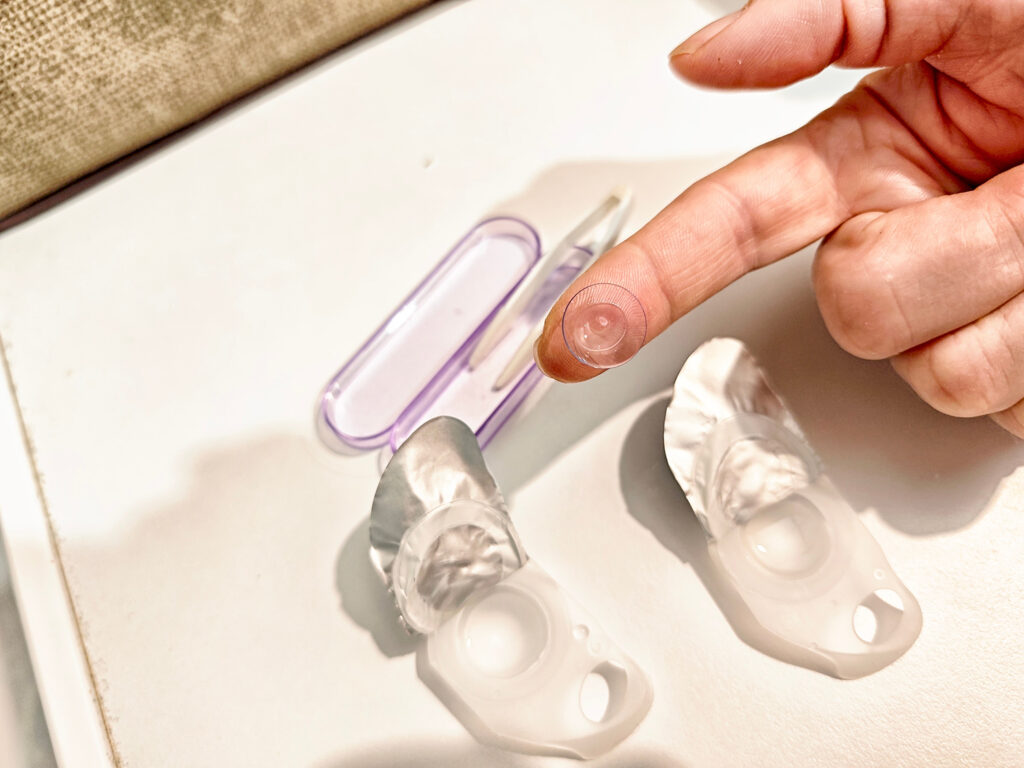
They are custom contact lenses designed by our residency trained contact lens specialist to help patients with complex refractive and/or corneal conditions. They include ortho-keratology (orthoK), scleral, rigid gas permeable (RGP), prosthetic, and specialty soft contact lenses.
Who Benefits From Speciality Contact Lenses?
These lenses have a wide range of applications, and can benefit patients who have:
myopia/in need of myopia control, details can be found (insert link to our myopia control page)
keratoconus and/or corneal dystrophy and degeneration, corneal scarring, conjunctival ingrowth etc.
dry eye including graft vs. host disease (GvHD), Sjögren’s syndrome, Steven’s Johnson syndrome, chemical or thermal burn
What Does a Typical Contact Lens Fitting Process Look Like?
Consult
Your doctor will review specific ocular assessments, including the profile of the shape of your ocular surface, to determine your candidacy for specialty contact lenses. Depending on your condition, a specialty contact lens trial may be conducted.
The program includes a training session where you get to learn how to insert, remove, clean, and take care of your specialty contact lenses. The program allows you to have multiple in-office visits over the course of a few months, as specialty contact lenses typically require several adjustments before they are finalized.
What is Myopia Control?
Myopia control is a preventative treatment that can work with your child’s growing eyes. The treatment is designed to slow eye growth. Without treatment, your child’s eyes can continue to grow longer in comparison to the curvature of the cornea, worsening myopia and potentially leading to lifelong vision complications.
What is Myopia?
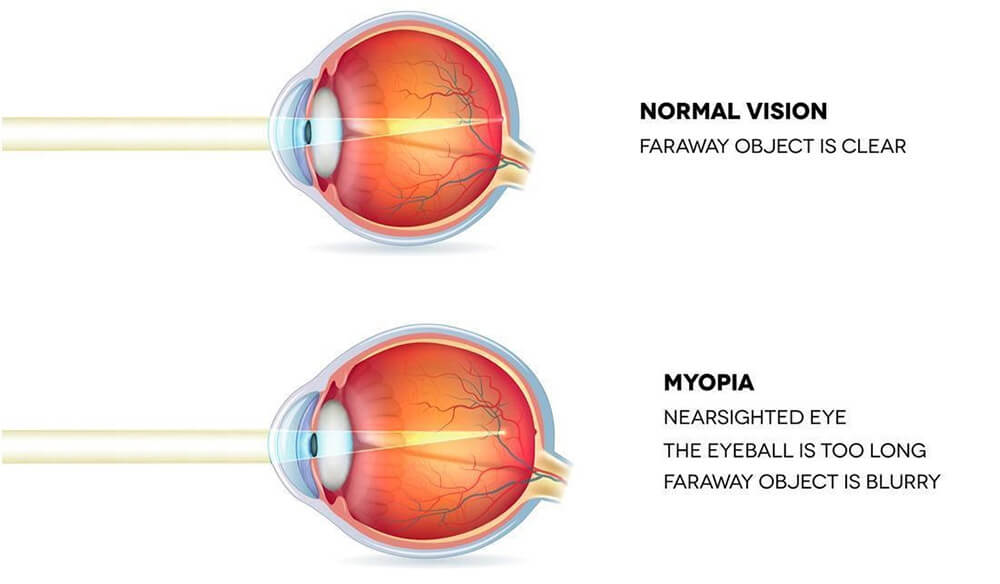
Myopia also known as “near-sightedness” is when an individual’s vision causes them to see clearly at near, but blurry at a distance. This is why it’s termed “near-sighted” because their vision is able to see at near only.
In a normal eye, the light rays are focused right on the retina. In a myopic eye, the light rays are focused in front of the retina. Glasses prescription or contacts will move that light ray to focus on the retina for clarity.
How Do You Slow Down Myopia?
Years of research has shown that optometrists can reduce myopia by using pharmaceutical eye drops, therapeutic contact lenses or therapeutic eyeglasses. The mode of action is to focus the light rays in the peripheral (side vision) in front of the retina so it does not signal the eye to grow longer.
Treatment Options at Prism Myopia Control Clinic
Atropine has been used in eye care for many years. Low doses of atropine have been studied to slow down the progression of myopia by up to 50%. Common side effects are blurriness at near and light sensitivity. These side effects are dose dependent and varies between children. These drops are made at the pharmacy and are used for night-time use.
Orthokeratology (Ortho-K) is an effective strategy for addressing myopia. These contact lenses are worn overnight for clear vision the next day. It reshapes the cornea overnight so you can be glasses-free. Think of Ortho-K as “braces” for your eyes. Braces help reshape your teeth so its more straight and Ortho-K lenses reshape your cornea so the light rays can hit your retina.
Ortho-K is not permanent so there is always an option to choose a different treatment option along the way. It currently is one of the best tools for myopia control and slows down myopia at a rate of 50-60%.
These contact lenses are worn during the day to reduce the progression of myopia. MiSight contact lenses is a Health Canada approved treatment for myopia control. It focuses the light rays in the peripheral (side vision) in front of the retina so it does not signal the eye to grow longer. It has been studied to slow myopia by 59%.
There are custom glasses that can alter the light ways to reduce eyeball elongation. HOYA’s DIMS Lens allows for clear straight-ahead vision, but the peripheral is less focused to control the myopia growth. The reduction of myopia in these glasses varies from 30-60%.
How Do I Get Started?
There are custom glasses that can alter the light ways to reduce eyeball elongation. HOYA’s DIMS Lens allows for clear straight-ahead vision, but the peripheral is less focused to control the myopia growth. The reduction of myopia in these glasses varies from 30-60%.
You will be scheduled for testing prior to seeing the doctor. This testing helps your doctor to plan your treatment and counsel you on the various options so that you can choose the best fit for your eye and your needs. Most of the testing and imaging required for specialty contact lens fit are not covered by OHIP. Prism will provide you with information about their purpose.
After checking in at the Optical Department, a technician will perform some preliminary tests. Your doctor and their team of associates will then examine your eyes and discuss the treatment options that are right for you.
FAQ’s – Scleral Contact Lenses
Scleral contact lenses are large-diameter, rigid gas-permeable lenses that rest on the white part of the eye (the sclera) rather than the cornea. They vault over the cornea and hold a reservoir of fluid, providing comfort, protection, and clear vision.
Scleral lenses create a constant fluid layer over the cornea, keeping the eye hydrated throughout the day. This helps reduce dryness, irritation, and sensitivity while protecting the surface of the eye.
Yes. Scleral lenses provide excellent vision, especially for patients with irregular corneas. By creating a smooth optical surface, they often deliver clearer, more stable vision than glasses or standard contact lenses.
Coverage varies depending on your insurance plan and diagnosis. In some cases, scleral lenses may be partially covered when deemed medically necessary. Our team will help review coverage and discuss costs with you. We offer financing options which include up to 18 months of zero interest payments.
The fitting process typically involves multiple visits to ensure the lenses fit properly and provide optimal comfort and vision. Because scleral lenses are custom-made, adjustments may be needed before finalizing the fit.
Yes. Scleral lenses are commonly used for patients who have had refractive surgery, corneal transplants, or other eye procedures, especially when vision or comfort remains an issue.
Unlike soft or standard rigid lenses, scleral lenses:
Do not rest on the cornea
Hold a fluid reservoir for hydration
Provide superior comfort for dry or irregular eyes
Offer highly customized fitting
In most cases, a referral is not required. However, if you are being referred by another eye care provider or specialist, we are happy to coordinate care.
A comprehensive evaluation at Prism Eye Institute will determine whether scleral lenses are appropriate for your condition and visual needs. Our specialists will review your options and answer any questions.
FAQ’s – Myopia Control
Progressive myopia increases the risk of future eye diseases such as retinal detachment, glaucoma, cataracts, and myopic macular degeneration. Slowing myopia progression can help protect long-term eye health.
Myopia control is most effective when started early, usually in children between the ages of 6 and 12. However, older children and teenagers may still benefit depending on their progression rate.
Myopia cannot be reversed, but its progression can often be slowed with appropriate treatment. The goal of myopia control is to reduce how quickly nearsightedness worsens over time.
We assess vision, eye growth, prescription changes, family history, and lifestyle factors. Advanced measurements allow us to track progression and determine whether myopia control treatment is recommended.
Yes. Myopia control treatments are evidence-based and widely used worldwide. When properly prescribed and monitored, they are considered safe and effective.
Most patients are monitored every 3–6 months, depending on age, treatment type, and progression rate. These visits help ensure treatment is working effectively and safely.
Excessive near work and limited outdoor time are associated with myopia progression. We provide guidance on healthy screen habits and encourage regular outdoor activity as part of a comprehensive management plan.
Coverage varies depending on the treatment and insurance plan. Some components may not be covered. Our team will review costs and options with you before starting treatment. We offer financing options which include up to 18 months of zero interest payments.
LET'S STAY CONNECTED
FOLLOW US ON SOCIALS TO KEEP UP WITH EVERYTHING HAPPENING AT PRISM EYE.
Speciality Contact Lenses and Myopia Control Doctors